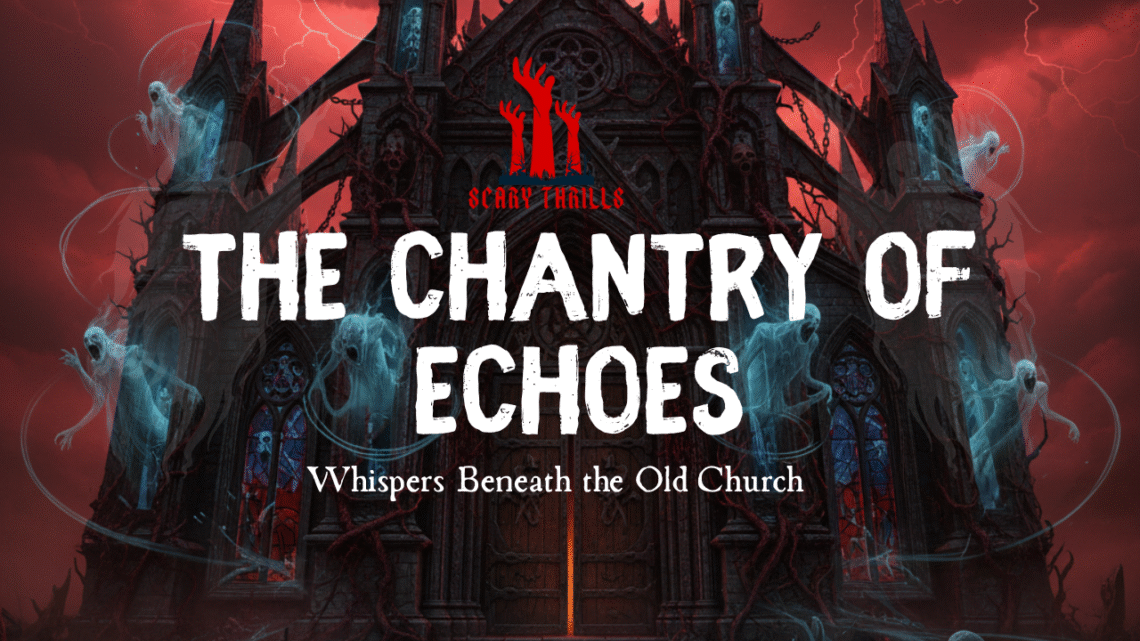
The air in the old St. Ignatius church was a physical presence, thick with the smell of damp stone, rotting hymnals, and the profound silence of abandonment. For Arthur, a linguist whose specialty was dead and dying languages, it was a cathedral of data. His employer, a property developer with a nervous disposition, had given him a simple task: identify the source of the “structural murmurs” recorded by their survey team. The locals, of course, had a simpler explanation. They said the church was built on a throat.
“It’s just groundwater, wind through fissures,” Arthur muttered to himself, setting up his sensitive recording equipment in the crypt. His voice was swallowed by the gloom. “Acoustical anomalies. Not ghosts.”
The first night yielded nothing but the creak of old timber and the skittering of unseen things. But on the second night, as the town’s clock tower struck a distant two AM, the whispers began.
They were not heard with the ear so much as felt in the marrow of the bone—a sibilant, multi-layered susurrus that seemed to rise from the very flagstones. Arthur’s digital recorder, a state-of-the-art device with a parabolic microphone, captured it all. He listened back through his headphones, his heart thudding a frantic rhythm against his ribs.
It wasn’t random noise. It had patterns, phonemes, a terrifying syntax. It was language.
For weeks, he became obsessed. He stopped returning emails, forgot to eat, and slept in fits on a camp cot beside his equipment. The whispers were a puzzle, a linguistic black hole pulling him in. He began to transcribe them, filling notebooks with jagged, unfamiliar symbols. The language was agglutinative, building complex, soul-crushing concepts from simpler, dreadful roots. There was no word for “love,” but seventeen distinct words for “void.” No term for “hope,” but a precise, guttural noun for “the sound a soul makes when it unravels.”
He started to hear them even when his headphones were off. A faint, papery rustle at the edge of his hearing as he boiled water for coffee. A sibilant sigh from the shadowy corner of the crypt. He told himself it was fatigue, an auditory hallucination born of intense focus.
Then the changes began.
He found himself writing words from the whispers in the margins of his notes without realizing it. His own thoughts started to feel… foreign. He would look at his hand and the word for “flesh-vessel” would echo in his mind. He would feel a pang of hunger and the concept for “the emptiness that consumes” would surface, unbidden.
One evening, he managed to decipher a short, looping phrase. It translated, roughly, to: “The stone is not a home. The stone is a mouth. We are the words it speaks.”
A cold terror, purer than any he had ever known, finally pierced his academic obsession. This wasn’t a language to be understood; it was a language that understood you. It was parasitic, mapping itself over your own mind, rewriting your consciousness with its bleak ontology.
He decided to leave. He had to. He began frantically packing his equipment, his hands trembling. As he reached for his laptop, a new whisper slithered from the walls, clearer than any before, a voice made of dust and forgetting.
“Why do you pack the vessel?” it asked, not in English, but in the deep, grammatical structures of the whisper-tongue. And the horrifying thing was, Arthur understood it perfectly.
He clapped his hands over his ears. “Stop! Leave me alone!”
“Alone is a false word,” the crypt whispered back, the sound now emanating from the very air around him. “There is only the chorus. You have learned the notes. Now you must sing.”
He stumbled towards the stone steps leading up to the nave, but the darkness there congealed, becoming solid, a wall of palpable silence that pushed him back. He was trapped. The whispers grew louder, not just around him, but inside him. His own internal monologue was being drowned out, replaced by the ancient, chilling lexicon of the stones.
He fell to his knees, a scream building in his throat. But when he opened his mouth, it was not a scream that emerged. It was a whisper, fluent and vile, speaking words of dissolution and eternal silence. He felt his sense of self, his memories, his very identity, fraying at the edges like old cloth, being unwoven into constituent sounds.
His body slumped against the cold wall, his eyes open but vacant. From his slightly parted lips, a new, hesitant whisper joined the ancient chorus. It was learning. It was practicing.
Arthur, the linguist, was gone. In his place was just another echo, another word in the endless, whispering sentence spoken by the mouth of the old church. And in the profound silence that followed the final integration, the chorus was richer, fuller, having added a new, perfectly enunciated syllable to its timeless, dreadful hymn.